
Why a kitchen needs its own hand wash point
In most kitchens we visit on the East Rand, hands get washed wherever there is a tap. That is usually the prep sink or the pot wash, which means raw chicken juice, dirty pans and hands all end up in the same bowl. Health inspectors look for a dedicated hand wash basin with hot and cold running water, soap and a hygienic way to dry hands, kept separate from the sinks used for food and utensils. It is one of the first things they check when a food premises applies for its certificate of acceptability under the R638 hygiene regulations.
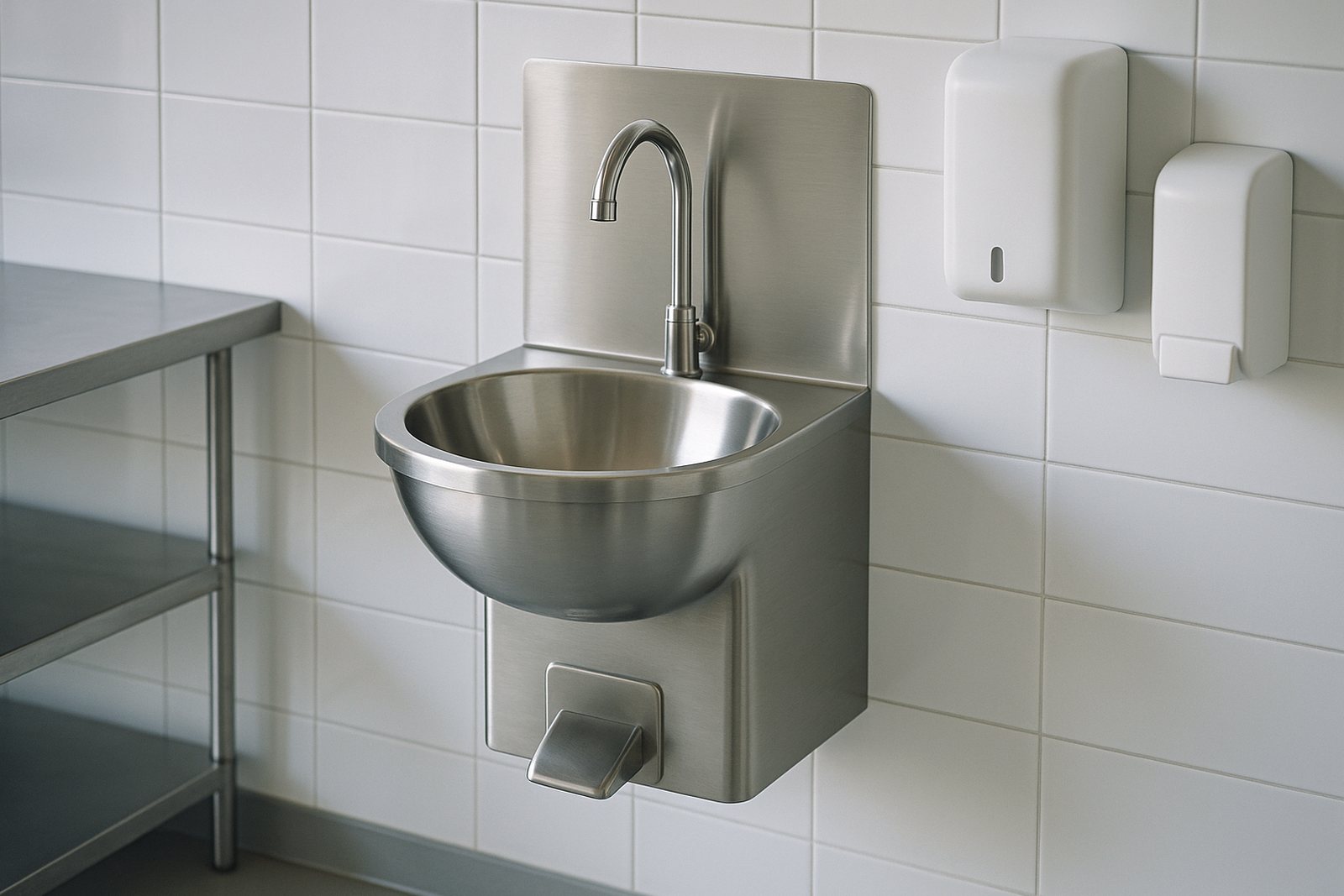
A basin on its own is only half the answer though. If staff have to turn a tap on with dirty hands and off again with clean ones, the clean hands go straight back to the tap handle. A knee valve fixes that. The cook pushes the panel under the bowl with a knee, water runs for a set time, and the valve shuts itself off. Nothing gets touched.
It also saves water. A tap left running in a rush wastes a lot more than people think, and a timed valve only gives what is needed for one proper wash.
How the basin is built
We make the basin in Benoni from 304 grade stainless steel, with a pressed round-cornered bowl that is easy to wipe out and a tall splashback welded in one piece so there is no seam for grime to sit in. It hangs on a concealed wall bracket and the knee panel sits under the bowl, with the valve and pipes boxed in behind a removable cover so a plumber can get to them.
The standard basin is 400 mm wide with a bowl about 150 mm deep. For narrow walls, trailers and container kitchens there is a compact 300 mm version, and for staff entrances in canteens and butcheries we make an 800 mm trough with two knee valves so two people can wash at once at shift change.
- Knee valve with timed flow, adjustable from about 7 to 20 seconds per push
- Hot and cold supply through a pre-mixed feed, or cold only where the regulations for the site allow it
- Short gooseneck spout set high enough for forearms, not just fingertips
- Optional brackets for a soap dispenser and a paper towel dispenser on the splashback
- Optional foot pedal valve instead of the knee panel for staff in long aprons
Where the water is very hard, like some boreholes around Bapsfontein and Delmas, we fit an inline strainer before the valve. Scale is what makes timed valves stick open, and a strainer is much cheaper than a new cartridge.
Where to put it
The best spot is where people walk into the food area, so washing hands happens before anything else. In a takeaway that is normally the doorway from the front counter to the back. In a butchery it is next to the cutting room door, and in a bakery near the mixer and bench. Keep it at least a metre away from open food or a splash guard on the side, and never directly above a prep table.
- Check the wallBrick or block takes heavy anchors. Drywall needs a backing plate before we hang the basin.
- Plan the plumbingHot and cold points about 500 mm above the floor, and a 40 mm waste nearby, make fitting much quicker.
- Set the heightRim at roughly 850 mm to 900 mm, knee panel at a height staff can push without bending.
- Fit the dispensersSoap on the side people reach with their dominant hand, towels where water does not drip onto them.
If you are planning the whole wash-up area at the same time, our note on sink placement covers how hand wash, prep and pot wash points work together. For odd spaces we can also build the basin into a custom sink unit or a run of stainless next to a single bowl sink.
Power cuts, hot water and daily care
The knee valve is fully mechanical, so the basin keeps working when the power goes off. What you do need to think about is hot water. A geyser holds its heat for a while after the power goes, but on a long cut or a busy evening it runs cold. Many of our clients in Benoni, Boksburg and Springs feed the hand wash point from a small gas water heater for that reason, which is a job for your plumber and gas installer.
Day to day, wipe the bowl and splashback with a mild detergent and a soft cloth, and rinse it off. Avoid steel wool and bleach left standing on the steel, because that is what leaves rust marks on stainless. Once a month, push the valve and count how long it runs. If it runs much longer than it used to, or drips after closing, the cartridge needs a clean.
Stock basins are normally ready in two to three working days. Compact, trough and custom sizes take about five to seven working days. We deliver across the East Rand and send units nationally, and your own plumber can fit it, or we can arrange the fitting with ours.
Key facts
| Product | Wall-hung hand wash basin with knee-operated timed valve |
|---|---|
| Material | 304 grade stainless steel, one-piece bowl and splashback |
| Sizes | 300 mm compact, 400 mm standard, 800 mm twin trough |
| Valve | Mechanical knee valve, timed flow about 7 to 20 seconds, foot pedal option |
| Utility needs | Hot and cold water and a 40 mm waste, no electricity or gas at the basin |
| Mounting | Concealed wall bracket, rim about 850 mm to 900 mm from the floor |
| Lead time | Stock sizes two to three working days, custom five to seven working days |
| Typical use | Prep rooms, butcheries, bakeries, takeaways, canteens and food trucks |