What A Soup Kettle Does In Daily Service
A soup kettle keeps food warm and ready for serving through a built-in heated well and a removable inner pot. It is made for holding, not cooking from scratch, so it works best once the product has already been cooked and brought up to serving temperature. In busy Benoni and Boksburg service points, that makes a real difference when lunch rush comes through in waves.
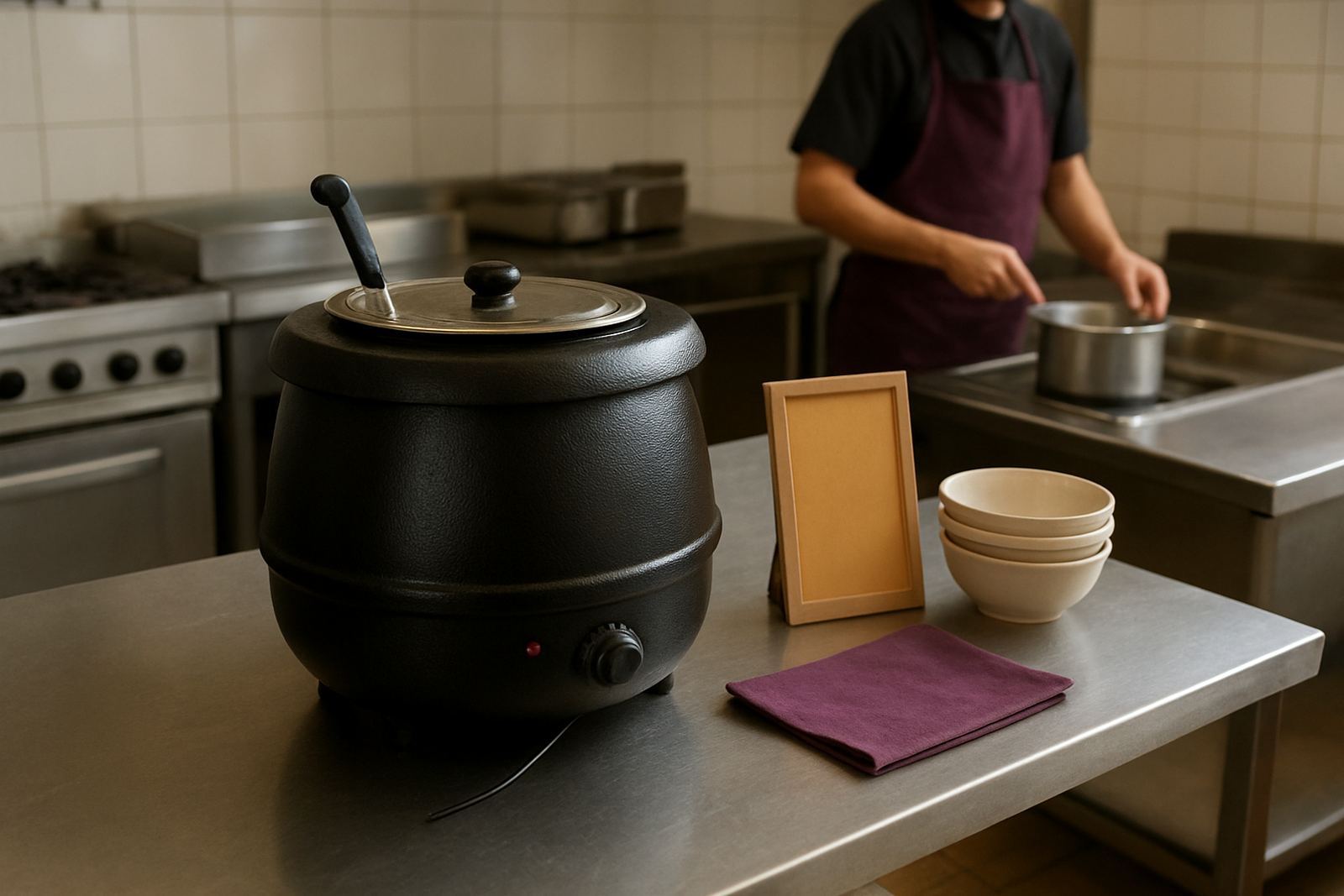
Most units use a round pot with a hinged or lift-off lid, a thermostat control and a stainless outer body. The operator can hold soups, cheese sauce, curry, gravy or vegetable stews at a controlled heat, then ladle portions quickly at a counter or buffet line. It is a simple unit but it saves time and keeps the serving area tidy.
If you are running a takeaway on the East Rand, or a canteen that sees school times and shift changes, the main benefit is consistency. Food stays at an even temperature and the front counter looks organised instead of crowded with loose pots and urns.
Sizes, Pot Types And Control Options
Soup kettles are usually supplied in single-pot countertop size, which keeps them easy to place on a prep ledge, serving counter or display base. Common capacities range from about 10 litres to 11 litres for compact service and 14 litres to 16 litres where higher volume is needed. The right size depends on how many portions you serve in one run and how fast the product turns over.
Typical options include a stainless outer body, a black powder coated outer shell or a chrome-plated finish, depending on the look you want at front of house. Some units use a dial thermostat with marked heat settings, while others have a simple on and off heat control. A clear lid is useful where staff need to check level quickly without lifting the cover every few minutes.
- 10 litre to 11 litre size for compact counters and low to medium volume use
- 14 litre to 16 litre size for busier self-service stations and lunch queues
- Stainless inner pot for faster cleaning and better resistance to wear
- Thermostat control for steadier holding temperature through service
Where It Suits Best In Kitchens And Front Counters
This product suits takeaways, cafés, caterers, contract feeding, tuck shops and service counters where hot food is presented in smaller batches. It also works well at staff canteens and school serving lines where soups and sauces need to stay presentable for a long period. For coastal areas and humid kitchens, stainless parts are worth asking for because they handle moisture better over time.
In a typical East Rand setup, the kettle might sit next to a bain-marie, under a servery shelf or on a stainless prep table during service. That makes it useful when space is tight and power points are already planned around the serving line. If your operation moves between sites, a compact unit is easy to carry and set down without special fixing.
- Takeaways and lunch counters
- School and staff canteens
- Events and function catering
- Hotels, guest houses and buffet areas
- Convenience food stations and forecourt counters
Installation, Power And Safety Checks
Most soup kettles are plug-in countertop units and need a standard electrical supply close to the serving point. Before ordering, check the available plug position, cable length and whether the counter has enough clear space for safe handling around the hot bowl. During load shedding, the unit will stop heating unless it is on backup power, so it is better to plan serving hours around the outage schedule if no inverter or generator is available.
Because the kettle is used with hot liquids, it should sit on a flat stable surface and not near the edge of the counter. Allow space for the lid to open fully and for a server to ladle without reaching awkwardly across other hot items. If the unit is placed in a self-service area, make sure customers can access it without knocking the handle or power cord.
Where your site has limited power points or older wiring, ask for a basic site check before the unit is commissioned. That helps avoid nuisance tripping when the kitchen already has fridges, heat lamps and a slicer running at the same time.
Care, Cleaning And Long-Term Servicing
Daily cleaning is important because soup salts, starch and sauces can mark the inner pot if they are left overnight. Allow the unit to cool first, remove the pot and lid, then wash with warm water and a non-abrasive cleaner. Wipe the outer body with a damp cloth and dry it properly so water marks do not build up along the rim and control area.
Check the thermostat knob, cable and plug regularly for wear, especially in kitchens that move equipment around for cleaning. If the unit starts heating unevenly, takes too long to reach temperature or trips the supply, it should be inspected before the next service period. A small fault can become a bigger repair if staff keep using it hard every day.
For operations in places like Germiston, Kempton Park and Springs where kitchens often run long shifts, a simple service routine helps extend the life of the unit. Keep the cord clear of hot surfaces, do not run the kettle dry and avoid using metal tools that can scratch the pot lining.
What To Confirm Before You Order
When you are choosing a soup kettle, check the capacity, finish, control type and whether you need one unit or more than one for separate menu items. It is also worth confirming the height and footprint so it fits your counter without blocking service flow. A kettle that is too small will need constant refilling, while one that is too large may be slow to heat for your use pattern.
- Capacity in litres and how many portions you serve per hour
- Electrical supply point and plug type on site
- Body finish for front counter use or back-of-house use
- Lid style, pot material and ease of cleaning
- Space available on the counter and clearance for ladling
- Whether you need matching equipment such as a bain-marie or display unit base
If your kitchen has a custom servery or stainless counter, the unit can be planned into the layout instead of being added later as an afterthought. That helps with cable placement, work height and the general look of the serving line, which matters in front-of-house areas where customers can see everything.
Key facts
| Product type | Countertop soup kettle for holding soups, sauces and hot liquids |
|---|---|
| Common capacities | 10 L to 11 L and 14 L to 16 L |
| Construction | Stainless outer body with removable inner pot |
| Power need | Standard plug-in electric supply, site dependent |
| Use case | Self-service counters, takeaways, canteens and buffet lines |
| Care | Cool first, remove pot, wash daily and inspect cable, plug and thermostat |