

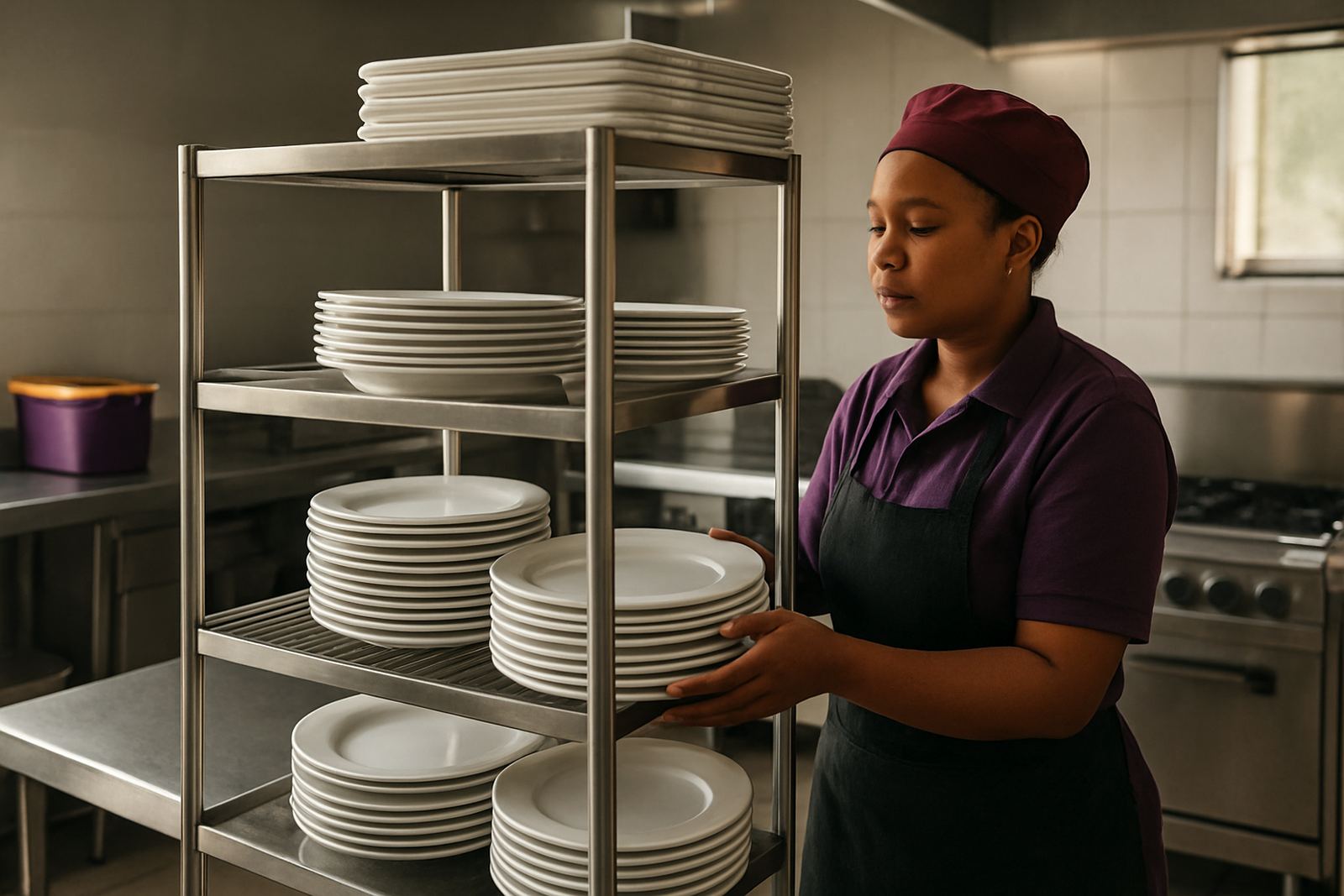
Plate Rack Shelving
Home / Catalogue / Plate Rack Shelving

Catalogue

Plate Rack Shelving

Plate rack shelving keeps plates, trays and serviceware within easy reach, without crowding prep counters or washing areas. It suits busy kitchens, takeaways and serving lines that need tidy storage and quick turnaround.

Open shelving for plates that must stay close to hand

Plate rack shelving is open storage made for stacked plates, saucers, platters and serviceware that need to be reached fast during service. It keeps crockery off the counter, reduces breakage from loose stacking, and gives staff a clear place to return clean items after washing. In a kitchen where space is tight, the right rack can make a noticeable difference to flow.

At CaterKraft we build plate racks in stainless steel for daily use in food areas where moisture, steam and frequent cleaning are part of the job. That includes hotel kitchens, canteens, takeaways, school kitchens and back-of-house prep areas in Benoni, Boksburg, Brakpan, Springs, Kempton Park and Germiston. The aim is simple: plates should be stored neatly, stay dry enough for handling and be ready when service starts.

  • Open access from the front for quick loading and removal
  • Raised shelves that suit stacked plates and serving trays
  • Stainless finish for wet areas and easy wipe-down cleaning
  • Can be matched to counters, wash-up stations or wall runs

Sizes, shelf spacing and build options

Plate rack shelving is usually made to suit the space on site rather than forced into a standard cabinet size. In a compact takeaway, a shorter unit may be enough for plates, side plates and a few serving bowls. In a larger kitchen, longer runs with more bays help separate clean stock from items going back into circulation. Shelf spacing matters as much as length, because tall stacks need enough headroom so staff do not scrape the top plates when loading.

Common options include single bay or multi-bay layouts, wall mounted units, free standing frames, and racks with a solid lower shelf for trays or containers. We can also add a back lip or side guards where items must stay in place during a busy shift. For coastal areas and humid kitchens, stainless choice and join quality matter because cheap mild steel fittings can stain fast and start to look tired after only a short time.

  • Length can be made to suit the available wall or floor space
  • Shelf heights can be set for dinner plates, coupe plates or platters
  • Wall mounted and free standing styles available
  • Optional lower shelf for trays, tubs or spare service items

Where plate racks work best in day to day service

These racks are most useful where speed and order count. A prep kitchen may use them near the pass so plates are ready before service starts. A takeaway may place one near the packing station so staff can load dishes without crossing the room. In a wash-up area, plate racks can help dry and store clean crockery while keeping the floor clear for safe movement.

They also suit servery areas in schools, retirement homes and staff canteens where people handle the same items many times a day. In smaller shops around the East Rand, a well-placed rack can free up a counter that was being used for everything from containers to paperwork. That is where the value shows up, not only in storage but in better movement around the kitchen.

  • Takeaways and fast service counters
  • Restaurant kitchens and pass areas
  • School and institutional serving lines
  • Wash-up rooms where crockery needs a drying and storage point
  • Prep areas with limited counter space

Installation, fixing and services to plan for

Plate rack shelving is normally straightforward to install, but the wall or floor it mounts to must be checked properly. If the unit is wall fixed, the wall should be sound and able to carry the full load of stacked plates. For freestanding units, the floor should be level so the rack does not rock when loaded. In older buildings across Benoni and Germiston, we often find uneven floors or patchy walls, so site measuring helps prevent problems later.

There is no gas or electrical demand for the rack itself, which makes it a practical choice during load-shedding and in spaces where power points are already spoken for. If the rack is being fitted near hot equipment, dishwash areas or extractor runs, we still check for heat, splash and movement paths. Good placement saves repairs later and makes cleaning easier.

  • Wall fixing requires a secure substrate or suitable reinforcement
  • Freestanding units need a level base and enough clearance for cleaning
  • No power or gas connection needed for the shelving itself
  • Can be measured on site where walls, corners or services affect the layout

Care, cleaning and service intervals

Stainless plate rack shelving is easy to maintain, but it still needs proper cleaning if you want it to last. Wipe it daily with warm water and a mild detergent, then dry the surfaces to avoid marks from standing water. In busy kitchens, fingerprints, steam residue and food splash build up faster than people expect. If the rack is near a sink or dish area, check the fixings regularly because vibration and constant handling can loosen fittings over time.

For coastal clients or kitchens with high humidity, it helps to keep the shelving dry after cleaning and to avoid leaving salt or chemical residue on the steel. If any welds, brackets or supports start to show wear, they should be checked early rather than after a shelf begins to sag. A small service visit can prevent a much bigger problem when the rush starts.

  • Clean daily with mild detergent and a soft cloth
  • Dry after washing to reduce spotting and staining
  • Check brackets and fixings monthly in busy service areas
  • Keep bleach and harsh chemicals rinsed off quickly

What to confirm before you order

Before ordering plate rack shelving, work out exactly what must sit on it and how many stacks you need to store at peak time. Measure the plates or trays, not only the wall space, because the shelf depth and gap between levels must suit the actual serviceware. It is also worth checking whether the rack will be used for return storage only, or for both drying and holding clean stock before service. Those details affect the finished layout.

We also advise confirming whether the unit must fit next to a counter, under a pass, or into a corner where access is limited. If the space has a skirting board, plumbing, a low shelf or a high splash area, the dimensions may need small changes. Getting those details right saves time on site and avoids a rack that looks good on paper but is awkward in daily use.

  • Plate diameter and approximate stack height
  • Available wall or floor length, width and clearance
  • Whether the rack must be wall mounted or freestanding
  • Nearby sinks, counters, doors or service points that affect access

Key facts

Material304 stainless steel standard, other grades available on request
Typical usePlates, trays, saucers and serviceware
FormatWall mounted or freestanding
Size rangeMade to order to suit site space
Power or gasNone required
Use areasKitchens, takeaways, servery lines and wash-up zones

What clients say

Questions we get asked

Can plate rack shelving be made to fit a small takeaway kitchen?

Yes. We can make shorter runs, narrower depths and shelf spacing that suits the plates or trays you use most often.

Does the shelving need electricity or gas?

No. The shelving itself needs neither power nor gas, which makes it useful in busy kitchens and during load-shedding.

Can you install in Benoni and other East Rand areas?

Yes. We work from Benoni and serve the East Rand, with delivery available nationally for ordered units.

Planning something? Email the team.

sales@caterkraftsa.co.za